 blog
blog
Best Spots for Intimate Group Dinners in Midtown East
Table of Contents
- Why Midtown East Is Ideal for Intimate Group Dinners
- How to Plan a Private Dinner Party: A Step-by-Step Guide
- Private Dining Etiquette Every Host Should Know
- Group Dinner Reservation Tips for Stress-Free Booking
- Top Picks for Intimate Group Dinners in Midtown East
- Conclusion
- Frequently Asked Questions
Last Updated: September 16, 2026
Why Midtown East Is Ideal for Intimate Group Dinners
Finding the best spots for intimate group dinners in Midtown East comes down to one thing: the neighborhood was built for occasions that need both polish and privacy. Tucked between the office towers of Sutton Place and the residential blocks near the East River, it offers quiet side streets, seasoned hospitality staff, and dining rooms small enough that your party of twelve never feels like a banquet hall booking.
- Proximity to corporate offices makes after-work team dinners and client meals easy to schedule
- Smaller dining rooms mean semi-private and full buyout options are genuinely attainable
- Experienced event coordinators handle logistics without drama
- Easy access from Grand Central or the nearby residential towers
For a birthday, rehearsal dinner, or corporate event, that removes most of the friction that makes group dining stressful.
How to Plan a Private Dinner Party: A Step-by-Step Guide
Planning a private dinner party means matching your guest list, budget, and menu style to a venue's capacity and policies before you commit to a date. Work backward from the guest count, since capacity and minimum spend drive nearly every other decision.
Define Your Guest List and Budget
Start with a firm headcount range, not an exact number. Venues price and configure rooms around capacity bands, and a party of fifteen to thirty needs different seating arrangements.
Budget deserves the same honesty. Ask about minimum spend, service charge, gratuity, and corkage before you fall in love with a space, these often matter more than the per-person figure quoted upfront.
Choose the Right Venue and Menu Style
Menu format shapes the evening. A prix fixe menu keeps timing tight and predictable, which suits corporate events. Family-style dining encourages conversation and works well for birthdays and rehearsal dinners where people linger.
Communal seating versus a pre-set menu is the other fork in the road. Long communal tables feel warmer and more social; individual place settings with a pre-set menu feel more formal. Neither is wrong, but they set a different tone.
Private Dining Etiquette Every Host Should Know
Private dining etiquette comes down to two phases: what you confirm in advance and how you run the room once guests arrive. Hosts who get a smooth evening treat the pre-event phase as a logistics document, not a courtesy note, and they push on the two things almost no guide covers: how the kitchen handles complex dietary needs at scale, and what the room can actually do with sound and screens.
Before the Event: Build a Single Confirmation Document
Send the venue one consolidated document, not a stream of texts. A useful confirmation covers:
- Final headcount plus a realistic range (venues configure rooms around capacity bands)
- Arrival time and the time you actually want the first course to land
- A single dietary list, not individual requests trickling in
- AV needs, spelled out (see below)
- Deposit and cancellation terms, restated back to you in writing
One clear message beats a dozen follow-ups and gives the coordinator something to hand the kitchen and floor team.
Dietary Restrictions: Collect Them as a Matrix, Not a List
The most common host mistake is treating dietary needs as a yes/no question. A serious allergy flagged verbally at booking and never reconfirmed forces the kitchen to improvise under pressure.
Collect restrictions as a matrix before you send anything to the venue:
| Restriction Type | What to Capture | Why the Kitchen Needs It |
|---|---|---|
| Allergies (peanut, tree nut, shellfish, etc.) | Severity and cross-contact risk | Determines whether a dish can be modified or must be replaced entirely |
| Gluten-free / celiac | Medical vs. preference | Celiac requires separate prep surfaces, not just a swapped ingredient |
| Vegan / vegetarian | Whether the guest eats dairy or eggs | Changes whether a prix fixe course can be adapted or needs a parallel dish |
| Religious / cultural | Pork, alcohol, halal, kosher-style | Affects sauces, stocks, and dessert courses that are easy to overlook |
| Dislikes (not restrictions) | Strong preferences | Helps the kitchen avoid wasted covers without treating it as a safety issue |
Send that matrix in one message and ask the venue to confirm what it can accommodate and flag what it cannot. A venue that handles this well confirms what it can accommodate and flags what it cannot.
AV and Tech: Ask Before You Assume
Corporate groups and celebration hosts both get burned by assuming a private room comes with working AV. Ask specifically:
- Is there a screen or projector, and is it mounted in the room or brought in on a cart?
- Is there a house microphone, and does the room have its own sound system or do you need to bring one?
- What is the Wi-Fi situation for guests presenting or joining remotely?
- Can the room be dimmed for a slideshow without killing the dinner ambiance?
- Is there a dedicated AV contact on-site, or does the event coordinator handle it?
A room that favors conversation over crowd noise is ideal for a toast, but a toast over a speaker system needs a different setup than one at a long table. Confirm which you are getting.
During the Event: Seating, Toasts, and Timing
Seat guests deliberately. Mixing groups at a long communal table works better than letting people default to their usual clusters. Share any seating chart with the coordinator so place cards and dietary flags land at the right seats.
Build a rough timeline for toasts and share it with the coordinator so the kitchen can pace courses around them, nothing derails a dinner faster than a toast landing mid-entrée. If you are running a slideshow or microphone, do a two-minute tech check before guests sit down.
Group Dinner Reservation Tips for Stress-Free Booking
Group dinner reservation tips start with one habit: book earlier than feels necessary and confirm every policy in writing.
Timing, Minimum Spend, and How Deposits Really Work
- Is the minimum spend on food and beverage only, or does it include the room fee?
- Does tax and service charge count toward the minimum, or sit on top of it?
- Is there a separate room rental fee, or is the minimum spend the only floor?
- What happens if your group spends under the minimum, do you pay the difference?
- Is there a corkage fee if you bring wine, and does it count toward the minimum?
- What is the deadline to reduce the headcount without penalty?
- If the event is cancelled, is the deposit refundable, partially refundable, or applied as a credit toward a future booking?
Noise Level and Acoustics: The Intimate Dinner Test
Intimate dinners require conversation, and conversation requires acoustics that do not force your group to shout.
Communicating Dietary Needs and AV Requirements
| Planning Step | What to Confirm | Why It Matters |
|---|---|---|
| Guest count | Capacity band and seating arrangement | Drives room configuration and minimum spend |
| Menu style | Prix fixe, family-style, or tasting menu | Sets pacing and formality of the evening |
| Dietary needs | Consolidated matrix sent in advance | Prevents last-minute kitchen improvisation |
| AV setup | Screen, mic, sound, and Wi-Fi availability | Avoids day-of surprises for toasts or presentations |
| Minimum spend | What counts toward it and what sits on top | Prevents an unexpected bill at the end of the night |
| Deposit terms | Cancellation window, refundability, and headcount deadline | Protects you if plans shift |
| Acoustics | Room separation and surface materials | Determines whether your group can actually talk |
Top Picks for Intimate Group Dinners in Midtown East
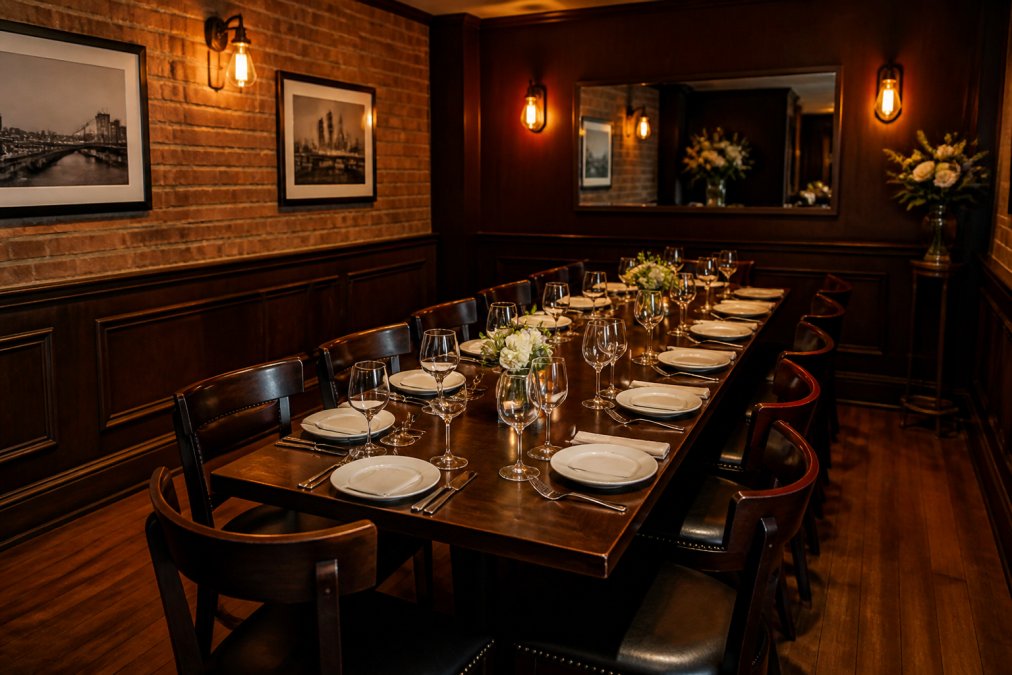
Booking is handled directly, and the team coordinates catering, seating, and dietary needs so the host can enjoy the evening.
Conclusion
The hardest part of planning an intimate group dinner is not finding a restaurant.
Frequently Asked Questions
What is the 30/30/30 rule for restaurants?
The 30/30/30 rule suggests that a restaurant should spend 30% on food costs, 30% on labor, and 30% on overhead, leaving 10% profit. For group dinners, this means venues balance quality and price. When booking, ask about service charges and minimum spends to understand the final cost.
How do you choose the right restaurant for a private group dinner?
Start by defining your event goals: size, budget, and vibe. Look for venues with private or semi-private spaces, flexible menus, and good acoustics. Check reviews for service consistency and dietary accommodations. In Midtown East, spots like Peggy's NYC offer intimate settings and custom menus. Always visit in person or call to discuss logistics, AV needs, and cancellation policies before committing.
What is the difference between a semi-private and private dining room?
A semi-private space is partially enclosed, often separated by screens or curtains, but still within the main dining area. It offers some intimacy but can be louder. A private room is fully enclosed, providing exclusive use and better acoustics for speeches. For intimate group dinners, private rooms are ideal for confidential conversations or celebrations. Semi-private works for casual gatherings where atmosphere matters less.
How far in advance should you book a private dining space?
For weekend evenings, book 4-6 weeks ahead, especially in popular Midtown East locations. Holiday season or large groups (20+) may require 2-3 months. Last-minute bookings are possible on weeknights but limit venue choice. Always confirm deposit and cancellation terms at booking. Early planning secures the best spaces and allows time for menu customization and dietary coordination.